VimalAbraham
If Elon Is Right About the Future of Work, What Does That Mean for the Rest of Us?
Oct 24, 2025
Every now and then, Elon Musk says something that sounds outrageous at first and then quietly lingers in your head. One of those that’s been lingering on my mind is his take on the future of work, that as AI and automation reshape our world, there’ll be a premium on human experience: what people can do, feel, and build that machines can’t.
He’s been saying versions of this for years, fewer managers, more makers; fewer credentials, more curiosity. And the longer I sit with it, the more sense it makes. Especially now, as a father of a high schooler sitting through conversations about subject choices and college majors, these kinds of comments hit differently.
They make me wonder: what does “future-proofing” even mean when the future itself won’t sit still?
We’re Already Living the Shift
I have what you could call an unhealthy relationship with ChatGPT. It’s there for everything, from the profound to the painfully mundane.
Choosing jeans? I ask Chat GPT. Comparing laptops? It decides, specs, reviews, even which store gives the best deal.
It’s replaced a few humans along the way. The tech-geek friend. The college counsellor, the therapist, the trainer. Now I just say, “Let’s ask ChatGPT.”
That’s what Musk means when he says AI is already part of how we live. It’s not waiting in the wings, it’s already in our conversations, our choices, and our daily decision-making. And somewhere in all that convenience, we have to ask what still belongs to us.
What Does This Mean for Jobs?
If AI is already embedded in everything we do, what does that mean for work itself?
The truth is, AI isn’t taking jobs the way we feared. It’s rewriting them, sometimes faster than we can read the fine print. In marketing, content writers have become prompt engineers.
In hiring, recruiters spend less time screening and more time storytelling. In design, the “blank page” doesn’t exist anymore, there’s always a co-pilot waiting.
The work doesn’t vanish, it evolves. And suddenly, the things that make people human, taste, judgment, empathy, timing, become the differentiation.
More than predicting job loss, Musk’s statements describe a re-balancing, where efficiency becomes the baseline, and creativity, intuition, and adaptability become the edge.
What Does It Mean for Skills & Education?
As a parent, that’s the part that worries me more than the math score. I can’t give my daughter a list of “safe” careers anymore.
On one hand, AI makes learning easier than ever. You can master economics, design, or code from your bedroom. Knowledge has been democratised; the “how” of learning is wide open.
But that accessibility also makes effort feel optional. When a chat bot can write your essay or plan your campaign, it’s easy to think the learning happened for you — when really, it happened around you.
That’s the tension this next generation will live with: the difference between using AI and being shaped by it.
But as a parent, I can help her build a mindset, one that values curiosity, critical thinking, and humility. Because those are the skills that don’t go out of style.
What Does It Mean for Leadership and Meaning?
If AI takes care of the rational, what’s left for managers, the people who sit in between strategy and execution, logic and emotion? For decades, we’ve expected managers to know things, to have the plan, the answers, the structure. But maybe that’s changing. Maybe the new role of a manager isn’t about control, but about context.
AI can analyse performance, prioritise tasks, even predict outcomes. But it still can’t tell you why something feels off in a team. It can’t spot the hesitation in a voice, or sense when someone’s disengaged even while nodding on a call.
That’s the new job of a manager, to make sense of what machines can’t. To translate data into meaning, to turn algorithms into action, and to keep the team human in the middle of all the automation.
The pessimist says AI will make managers obsolete. The optimist says it will make them superheroes.
The realist knows it will make them redefine what managing actually means.
The Quiet Takeaway
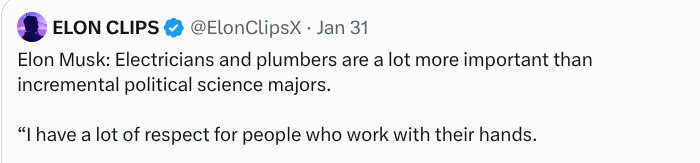
Musk’s prediction isn’t about everyone turning into electricians. It’s a reminder that the future will belong to people who stay interested. People who build, connect, and create meaning even as the world automates around them.
And for parents like me, that’s both comforting and unsettling. Because the truth is, we can’t give our kids safety anymore. But we can give them something stronger, the curiosity to stay relevant.
Because in the future of work, the most important skill might not be coding or managing. It might simply be remembering what it feels like to stay human.